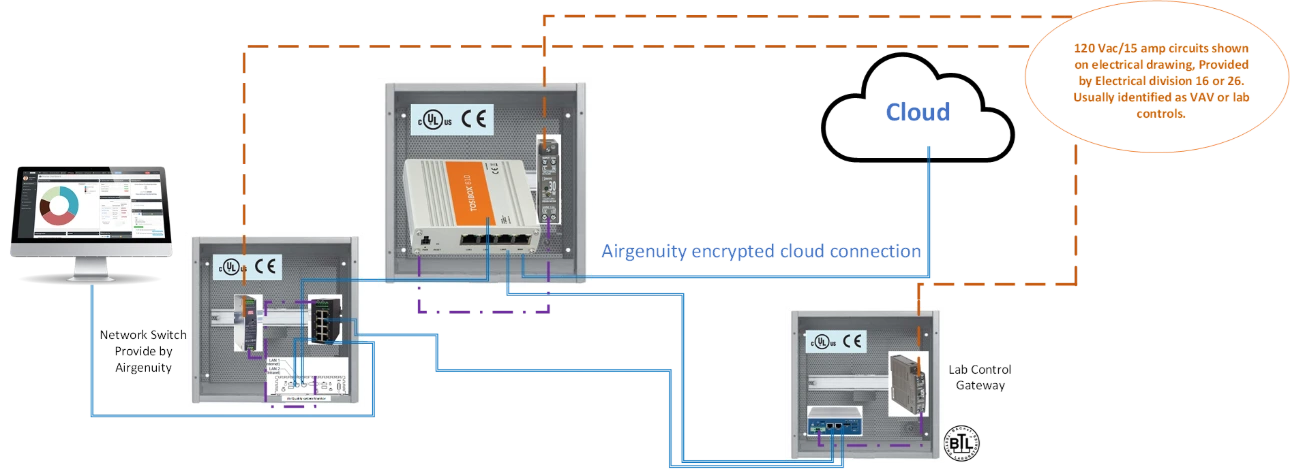
The Simple Answer
A laboratory airflow-control system may involve:
- Mechanical contractors
- Electrical contractors
- Controls contractors
- BAS contractors
- TAB professionals
- Commissioning teams
- Equipment manufacturers and suppliers
Each may have a clearly defined scope.
But airflow control doesn't operate in separate scopes.
A Venturi valve needs a controller. The controller needs programming. Sensors need to communicate with the control system. The control system needs to interact with the BAS. The mechanical system needs to be balanced correctly. The finished sequences need to be tested and commissioned.
The specification divides the work. The operating system brings the work back together.
That connection is where coordination becomes critical.
Why Does This Matter?
The system is only as good as the interfaces between its components
Canadian construction specifications are intentionally divided into trades and systems. The Canadian National Master Construction Specification, for example, separates HVAC work in Division 23 from Integrated Automation in Division 25 and Electrical work in Division 26. Division 25 includes areas such as controllers, instrumentation, system integration, control sequences, and commissioning.
That division of work provides important clarity.
But it can also create interfaces.
A typical laboratory project might look something like:
Division 23 — Mechanical
Mechanical system, ductwork, Venturi valve installation and balancing
↓
Division 25 — Integrated Automation
Controllers, instrumentation, sequences, networks and BAS integration
↓
Division 26 — Electrical
Building power and electrical infrastructure
↓
Commissioning
Verification that the completed systems operate according to the design intent
Each scope can be completed correctly while problems still occur between the scopes.
That is the gap a coordinated approach needs to address.
Where Laboratory Controls Cross the Lines
Consider a Venturi valve.
The valve itself may fall within the mechanical contractor's scope for installation. But the valve cannot provide dynamic airflow control without the associated control system.
The system also requires:
- A controller
- Programming
- Appropriate sensors
- Power
- Controls wiring
- Control sequences
- Communication
- BAS integration
- Commissioning
Now consider what happens when each element belongs to a different contractor.
Who verifies that the controller is programmed correctly?
Who confirms that the valve responds correctly?
Who verifies that the room-pressure sensor is communicating?
Who confirms the BAS is receiving the correct information?
Who makes sure the sequence actually produces the intended laboratory conditions?
Those questions aren't always answered simply by identifying which specification division contains each component.
The interfaces need to be deliberately coordinated.
Mechanical Balancing and Airflow Control Are Not the Same Thing
One particularly important interface occurs during balancing.
Venturi valves are designed to control airflow dynamically. They should not be used as a substitute for balancing the mechanical system.
During mechanical balancing, the airflow-control valves need to be placed in a neutral position so the mechanical system can be properly balanced without the control valves continually adjusting the airflow.
Once balancing is complete, the control system can take over its intended role.
This distinction is important because:
Mechanical balancing establishes the system's baseline.
Airflow control maintains the required operating conditions as the system changes.
Treating the two functions as interchangeable can make commissioning more difficult and can obscure the source of performance problems.
What Does a Coordinated Delivery Approach Look Like?
A coordinated laboratory controls solution should address the system throughout its lifecycle rather than treating equipment supply as the end of the manufacturer's responsibility.
1. Design and Shop Drawings
The control system begins with documentation that clearly establishes the intended architecture, devices, sequences, and interfaces.
For laboratory projects, this can include the relationship between Venturi valves, fume hood controls, room pressure sensors, occupancy sensors, temperature sensors, AQMS equipment, controllers, and the BAS.
2. Equipment and Controls
The physical equipment needs to be selected and configured as a system rather than as isolated components.
Depending on the project, this may include:
- Venturi valves
- Laboratory controllers
- Fume hood valves
- Sash Position Sensors
- Fume Hood Monitors
- Occupancy sensors
- Temperature sensors
- Smart room pressure sensor kits
- AQMS equipment
- Power supplies and transformers
- Controls wiring
- AQMS sampling tubing
3. Programming
Programming should reflect the project's sequences and design intent.
Pre-programming controllers before they reach the site can reduce the amount of configuration required during installation and provide a defined starting point for commissioning.
4. Installation and Coordination
Not every component necessarily gets installed by the same trade.
For example, the mechanical contractor may install the Venturi valves, while controls-level wiring may be carried by the controls contractor depending on the project's procurement model.
The important issue is not that one party physically performs every task. It is that someone understands how those tasks connect.
5. Integration
Laboratory controls frequently need to communicate with the building automation system.
That integration is where the laboratory control sequences, room conditions, alarms, monitoring points, and broader building controls need to come together.
Integration therefore needs to be considered as part of the system—not something left until the end of construction.
6. Commissioning
Commissioning is where the individual pieces become a functioning system.
Controllers, sensors, valves, sequences, communications and BAS integration need to be tested together.
The Canadian NMS recognizes commissioning and integrated automation as defined areas of work, including startup verification, operational acceptance testing, system integration and control sequences.
This is also where issues at the interfaces between trades often become visible.
What Does "Turnkey" Mean in Practice?
The term turnkey can sometimes imply that one company performs every part of the installation.
That isn't necessarily what it means for laboratory controls.
A more useful definition is:
A coordinated delivery model in which the laboratory control system has a clear technical owner from design documentation through commissioning, while individual trades retain responsibility for their defined portions of the project.
This approach allows the project to maintain its normal division of work while reducing the risk of gaps between those divisions.
A Typical Responsibility Map
The exact division of responsibility should always follow the project's specifications, contract documents, and procurement model.
However, a typical project may involve:
| Project Area | Typical Project Responsibility | Key Interface |
|---|---|---|
| HVAC / mechanical system | Mechanical contractor | Airflow requirements |
| Venturi valve installation | Mechanical contractor | Valve ↔ controls |
| Laboratory control equipment | Lab controls / controls scope | Devices ↔ controllers |
| Controllers and programming | Integrated automation / lab controls | Sequences ↔ devices |
| Controls-level wiring | Project-specific | Devices ↔ controllers |
| Building electrical power | Electrical contractor | Power ↔ controls equipment |
| AQMS tubing | Project-specific | Sampling network ↔ AQMS |
| Mechanical balancing | Mechanical / TAB | Balanced system ↔ airflow control |
| BAS integration | Integrated automation / BAS scope | Lab controls ↔ building system |
| Commissioning | Project commissioning team / applicable trades | Complete system |
Division assignments and responsibility vary by project. This map illustrates typical interfaces rather than establishing a universal contract scope.
The "Glue" between Scopes
A well-written specification can clearly define the individual responsibilities.
But a laboratory control system still needs someone to coordinate the relationships between them.
Consider what happens when:
- A valve is installed correctly but not communicating.
- A controller is programmed correctly but receives the wrong sensor signal.
- The BAS connection is complete but the laboratory sequence is incorrect.
- The mechanical system has not been properly balanced.
- The individual components work but the complete sequence does not produce the intended room conditions.
None of these problems necessarily means that a particular component is defective.
They are system problems.
And system problems often occur at the interfaces between scopes.
That is why coordination, integration, and commissioning are such important parts of laboratory controls.
What Is Included in a Turnkey Laboratory Controls Solution?
A complete laboratory airflow-control solution can extend across the entire project lifecycle:
1. Design & Documentation
- Laboratory controls shop drawings
- Control architecture
- Device schedules
- Sequences of operation
- Coordination with mechanical and electrical scopes
2. Equipment & Hardware
- Venturi valves
- Laboratory controllers
- Fume hood valves
- Sash Position Sensors
- Fume Hood Monitors
- Occupancy sensors
- Temperature sensors
- Smart room pressure sensor kits
- AQMS
- Power supplies and transformers
- Network switches
3. Installation
- Controls-level wiring
- AQMS sampling tubing
- Device installation coordination
- Valve installation by mechanical contractor
4. Programming & Configuration
- Controllers pre-programmed
- Device configuration
- Control sequences
- Alarm configuration
- AQMS configuration
5. Integration
- BAS integration
- Network communications
- Laboratory control system integration
- Coordination with other building systems
6. Startup & Balancing Support
- System startup
- Valve neutralization for mechanical balancing
- Device verification
- Controls checkout
7. Commissioning
- Functional testing
- Sequence verification
- BAS point verification
- Airflow/control verification
- Troubleshooting and coordination
8. Training & Support
- Operator/contractor training
- Documentation
- Post-commissioning support
- Technical service
Turnkey means the solution doesn't stop at equipment delivery. It follows the system through the stages required to make it operational.
How This Approach Is Applied to AirGenuity Projects
AirGenuity's laboratory controls offering is structured around this connected approach.
The scope can extend from laboratory controls shop drawings and equipment supply through programming, controls-level installation, BAS integration, commissioning, training, and ongoing technical support.
Venturi valves are supplied for installation by the mechanical contractor, while the controls system and associated devices are configured and integrated as part of the laboratory control scope.
Controllers can be pre-programmed before arriving on site. During commissioning, the system is integrated with the BAS and tested as a complete control system.
The goal is not to replace the responsibilities of the mechanical, electrical, controls, or BAS contractors.
It is to make sure the laboratory airflow-control system has a technical partner connecting those responsibilities together.
What Should Consultants and Contractors Look for?
When reviewing a laboratory controls scope, it can be useful to ask questions beyond simply "Who supplies the valve?"
For consultants
Consider whether the specification clearly addresses:
- Control system architecture
- Device responsibilities
- Control sequences
- BAS interfaces
- Programming
- Controls-level wiring
- Mechanical balancing requirements
- Commissioning responsibilities
- Integration testing
- Training
- Post-commissioning support
For contractors
Consider:
- Who supplies each component?
- Who installs it?
- Who programs it?
- Who provides controls wiring?
- Who handles BAS integration?
- Who coordinates with TAB?
- Who commissions the system?
- Who troubleshoots problems that occur between components?
- Who remains available after commissioning?
The clearer these interfaces are before construction begins, the less likely they are to become problems during commissioning.
From Specification to Performance
Laboratory controls are ultimately about more than individual components.
The Venturi valve, controller, sensor, BAS connection, sequence and commissioning process all contribute to the final performance of the laboratory environment.
The specification defines the pieces.
The trades deliver the pieces.
Coordination connects the pieces.
Commissioning proves that they work together.
A turnkey approach to laboratory controls is therefore less about having one company perform every task and more about having clear technical continuity from design through operation.
For consultants and contractors alike, that continuity can make the difference between a collection of correctly installed components and a laboratory control system that actually performs as intended.
One Sentence to Remember
A specification can divide the work—but a successful laboratory control system depends on connecting it.