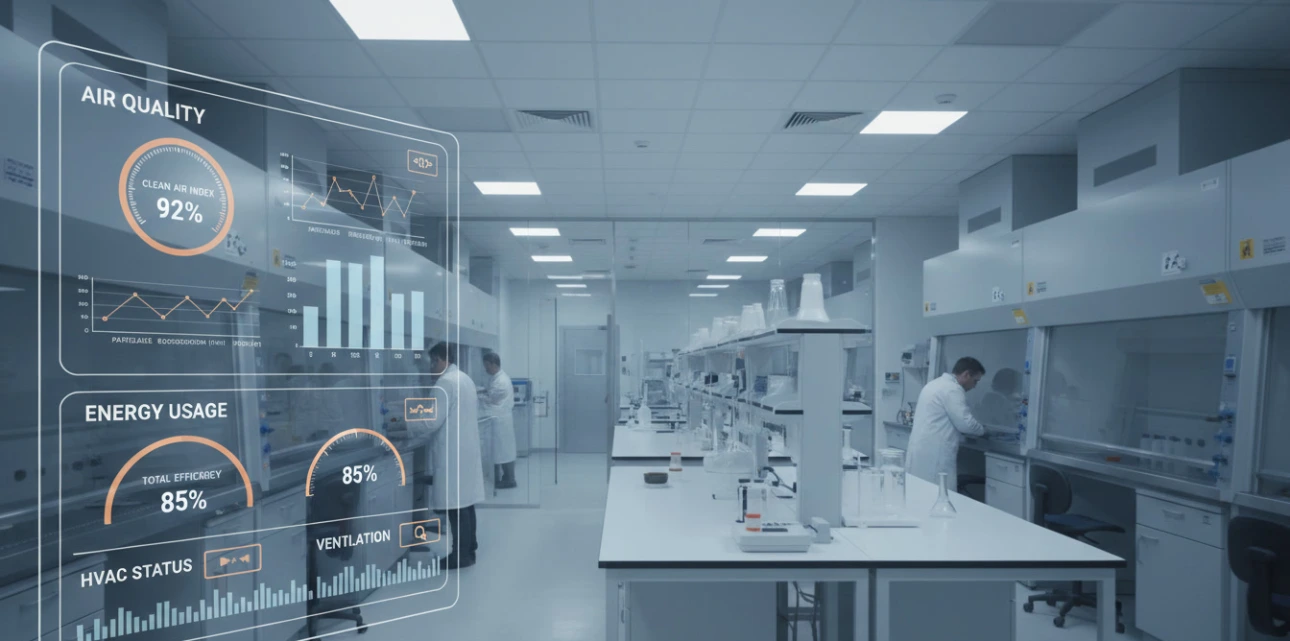
The problem with running maximum airflow all the time
A traditional laboratory ventilation system may be designed to provide a high level of airflow and then operate close to that level regardless of what is happening in the laboratory.
But laboratory demand is not constant.
A fume hood may be closed. A laboratory may be unoccupied. Contaminant levels may remain low. Cooling loads may change.
At those times, continuing to move, heat, cool and exhaust the same volume of air can consume significant amounts of energy without providing a corresponding increase in safety.
ASHRAE identifies several factors that can determine laboratory airflow, including exhaust from containment devices, cooling loads, minimum ventilation requirements and the airflow needed to maintain pressure relationships.
This means that maximum airflow is not automatically the same thing as maximum safety.
Safety comes from maintaining the required conditions—not from using the most air possible
One of the most common misconceptions about laboratory energy efficiency is that reducing airflow means reducing safety.
The reality is more nuanced.
A laboratory ventilation system needs to maintain the conditions required for the specific space, hazards and processes. Those conditions may include:
- Appropriate fume hood performance
- Required room pressure relationships
- Minimum ventilation requirements
- Adequate exhaust from laboratory equipment
- Containment of airborne contaminants
- Appropriate temperature and humidity
- Required airflow during hazardous processes
ASHRAE describes the laboratory airflow control system as an integrated system whose purpose includes controlling exposure to airborne hazards while also meeting environmental requirements for occupants and processes.
The objective, therefore, is not:
"How little air can we use?"
It is:
"What is the appropriate amount of air for the laboratory's current conditions?"
What is demand-based laboratory ventilation?
Demand-based ventilation uses information about the laboratory's actual operating conditions to determine how much ventilation is required.
Instead of assuming the laboratory always needs maximum airflow, the control system can respond to changing conditions.
Depending on the application, information may include:
- Fume hood sash position
- Fume hood airflow or face velocity
- Room pressure
- Occupancy or presence
- Air quality and contaminant measurements
- Particle levels
- Equipment or process conditions
- Temperature and cooling demand
The control system uses this information to adjust airflow within the defined operating limits of the laboratory.
When demand increases, ventilation can increase.
When conditions allow, ventilation can decrease.
This is the fundamental idea behind Demand Control Ventilation (DCV) and other forms of intelligent laboratory airflow control.
From fixed ventilation to intelligent control
Consider a laboratory with several fume hoods.
At 10 a.m., multiple researchers may be actively using the hoods. Sashes are open and exhaust demand is high.
At 8 p.m., the laboratory may be largely unoccupied and the hoods may be closed.
A fixed-volume system may continue operating at essentially the same ventilation rate during both periods.
An intelligently controlled variable-air-volume system can respond differently.
High demand
→ Increase required airflow
Normal demand
→ Maintain the required operating condition
Low demand
→ Reduce airflow where permitted
Changing or abnormal conditions
→ Increase airflow or initiate the appropriate alarm/control response
The energy opportunity comes from avoiding unnecessary airflow during those periods when maximum ventilation is not required.
Why fume hoods are an important part of the equation
Fume hoods are one of the largest drivers of laboratory exhaust airflow.
Variable-volume fume hood systems can adjust exhaust airflow based on factors such as sash position or measured face velocity. ASHRAE identifies these approaches as ways of controlling airflow while maintaining the required hood operating condition.
That creates an important opportunity.
When a hood is being actively used, the system needs to provide the airflow required for the application.
When the sash is closed, however, the required airflow may be substantially different.
Automatic sash management and variable-volume control can therefore reduce unnecessary exhaust airflow and, consequently, the energy required to move and condition replacement air.
This is one reason laboratory energy optimization cannot be separated from fume hood performance.
The role of real-time monitoring
Demand-based control becomes much more powerful when the system can see what is actually happening in the laboratory.
For example, air-quality monitoring can provide information about whether contaminant or particle conditions are changing.
McMaster University's laboratory ventilation work provides a useful Canadian example. Its Net Zero Carbon Roadmap describes laboratory DCV using pressure-independent Venturi VAV units together with active particle and contaminant monitoring. The approach was implemented in several laboratory areas, including the Michael DeGroote Centre for Learning and Discovery (MDCL).
McMaster's more recent Energy Management Plan also identifies DCV as an energy-saving strategy in laboratory renovations, noting that reducing ventilation during periods of lower use can reduce electricity and natural gas consumption.
The important lesson is not simply that "sensors save energy."
It is that:
Monitoring provides the information needed for the control system to respond to actual conditions.
The example: MDCL
The Michael DeGroote Centre for Learning and Discovery at McMaster University provides a useful example of this approach.
Laboratory spaces at MDCL were among the McMaster facilities where demand-controlled ventilation was implemented. The broader strategy incorporated variable-volume airflow control and monitoring to allow ventilation to respond more closely to laboratory conditions.
The project illustrates an important principle:
Energy efficiency can be incorporated into laboratory ventilation without treating safety and energy performance as competing objectives.
Instead, the ventilation system can be designed to respond to demand while maintaining the conditions required for the laboratory.
How do you know if your laboratory has an energy opportunity?
Before changing ventilation rates, look at how the laboratory actually operates.
Some useful questions include:
- Does ventilation remain near maximum even when laboratories are lightly occupied?
- Are fume hood sashes routinely left open when hoods are not being used?
- Are supply and exhaust airflow trends available?
- Are room pressure trends being monitored?
- Do airflow levels respond appropriately to changing fume hood demand?
- Are sensors regularly calibrated?
- Has the control sequence been functionally tested?
- Are there periods when the laboratory is operating at significantly lower demand?
- Are heating and cooling costs unusually high relative to laboratory use?
These questions can reveal whether the problem is simply too much ventilation, or whether the deeper problem is that the system isn't responding to changing demand.
The bigger opportunity: controlling the laboratory as a system
The greatest energy opportunities comes from coordinating the entire ventilation system.
- A fume hood changes.
- The airflow control responds.
- Room supply and exhaust adjust.
- Room pressure is maintained.
- Air-quality conditions are monitored.
- The building automation system receives the appropriate information.
- And the system responds again as laboratory conditions change.
This is what makes intelligent laboratory ventilation different from simply turning the air down.
The system is continuously matching ventilation to demand while operating within the laboratory's required safety envelope.
The Bottom Line
Laboratory energy savings should not come from simply reducing airflow.
They come from intelligently controlling ventilation within the laboratory's required safety envelope—providing more airflow when conditions demand it and less when they don't.
When accurate monitoring, responsive airflow controls and properly commissioned sequences work together, laboratories can reduce unnecessary ventilation energy while continuing to protect the people, processes and research inside the space.
The goal isn't to use less air. The goal is to use the right amount of air at the right time.