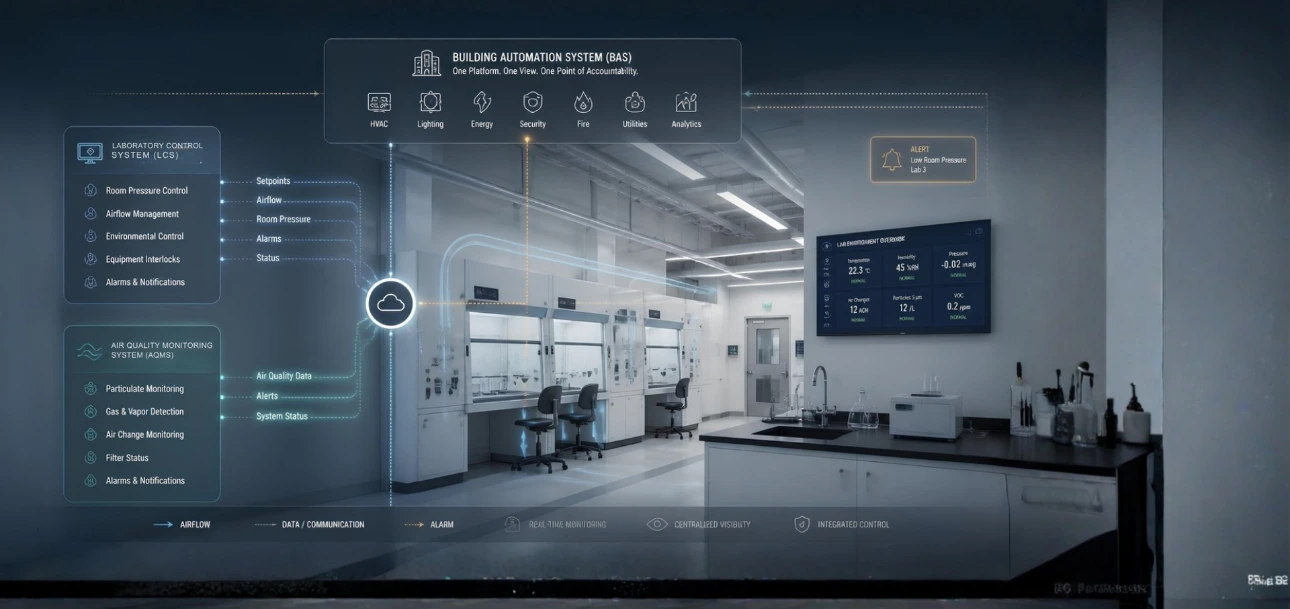
The Problem with Multiple System Suppliers
When laboratory controls and environmental monitoring are supplied by different companies, the two systems still need to communicate.
The laboratory controller generates information about the operation of the space—such as airflow, pressure, alarms, and other control parameters. The monitoring system needs access to that information to provide facility staff with visibility into laboratory performance.
In many installations, this communication occurs through the Building Automation System (BAS).
The BAS can provide an effective central platform for integrating building systems. However, introducing another system into the communication path can also introduce additional configuration and integration requirements.
For example, BACnet points may need to be mapped between systems so that the correct information is transferred, displayed, and monitored.
This creates another layer that must be configured correctly and maintained over the life of the system.
Every Integration Layer Creates Another Opportunity for Failure
The issue is not that BAS integration is inherently unreliable. BAS integration is an important part of modern laboratory facilities and provides valuable centralized visibility.
The issue is what happens when multiple independent systems and suppliers are involved.
Each additional integration layer creates opportunities for:
- Incorrect or missing point mapping
- Communication problems
- Configuration changes
- Data becoming unavailable or unreliable
- Software or BAS upgrades affecting previously functioning points
- Uncertainty about which supplier is responsible for resolving the problem
The result can be a surprisingly simple problem that takes a surprisingly long time to diagnose.
A facility manager may see that monitoring data has disappeared. The laboratory controls may still be operating correctly. The monitoring system may also be functioning correctly.
So where is the problem?
Is it the controller?
Is it the monitoring system?
Is it the BAS?
Was a BACnet point changed?
Did a software update alter the configuration?
When different companies are responsible for different parts of the system, answering those questions can become the first step in the troubleshooting process.
One Supplier Creates One Point of Accountability
When the laboratory controller and monitoring system are supplied and supported by the same company, troubleshooting becomes much more straightforward.
The supplier has visibility into both systems and can determine whether the problem originates with the controller, the monitoring system, or the communication between them.
This creates a single point of accountability.
Instead of coordinating multiple vendors and asking each one to investigate its own equipment, the facility can work with one supplier to diagnose the complete system.
That can mean:
Faster troubleshooting.
The supplier does not have to wait for another vendor to investigate its portion of the system before determining what is happening.
Lower service costs.
Issues can potentially be diagnosed and corrected remotely, reducing unnecessary site visits.
Less downtime.
Problems can be identified and resolved more quickly when the entire system can be investigated together.
Fewer communication gaps.
There is less opportunity for information to be lost between suppliers during troubleshooting.
Clear ownership.
There is no ambiguity about who is responsible for finding the problem.
A Common Issue : Data Disappears After a BAS Update
One warning sign of an integration problem is when monitoring data suddenly becomes unavailable or unreliable after a BAS upgrade, software update, or configuration change.
At first, this may appear to be a hardware failure.
But the hardware may be working perfectly.
The laboratory controller may still be generating the correct information, while the monitoring system is no longer receiving one or more of the expected points.
In this situation, the problem may simply be a change in point mapping or controller configuration.
This is where having one supplier responsible for both systems can make a significant difference.
The first step is to verify that the laboratory controller is still generating the correct data and then determine whether the monitoring system is receiving it.
If both systems are supported by the same supplier, that investigation can often begin remotely.
In some cases, restoring the controller configuration or reloading a known-good backup may be enough to bring the missing points back online—without requiring multiple vendors to visit the facility.
A Real-World Example: A renown College
This is exactly the type of situation we encountered at one of our College Customers.
A communication issue caused monitoring points to become unavailable.
Because both the laboratory controller and monitoring system were supported by AirGenuity, our team was able to investigate the issue and remotely restore the controller configuration.
The missing points came back online without requiring multiple vendors to determine where the problem originated.
The benefit was not simply that the problem was fixed.
The bigger benefit was how quickly the problem could be identified and resolved because one supplier had visibility into the complete system.
Does a Single Supplier Mean the BAS Is No Longer Important?
No.
The BAS remains an important part of laboratory building management. Laboratory control systems are commonly integrated with BAS platforms so facility teams can access trends, alarms, and operating information centrally.
The advantage of a single supplier is not eliminating the BAS.
It is reducing the number of independent parties and integration responsibilities between the laboratory controls and the monitoring system.
The BAS can remain the central building-level platform while the laboratory control and monitoring systems are designed and supported as a coordinated solution.
What Should Owners and Consultants Consider?
When evaluating laboratory controls and AQMS, the question should go beyond the initial equipment cost.
Consider who will be responsible for the system after commissioning.
Ask:
- Who is responsible if monitoring points stop communicating?
- Who can troubleshoot both the laboratory controller and monitoring system?
- How much of the integration depends on third-party point mapping?
- Can the supplier remotely access and diagnose the system?
- Who is responsible after a BAS or software upgrade?
- Can a known-good controller configuration be restored if communication is lost?
- Will the facility need to coordinate multiple vendors when a problem occurs?
These questions can reveal an important part of the system's total cost of ownership that may not appear in the original equipment price.
The Bottom Line
Using a single supplier for laboratory controls and air quality monitoring does not simply simplify procurement.
It can simplify the entire life of the system.
When the same supplier is responsible for both the laboratory control system and the monitoring system, there are fewer communication gaps, fewer integration responsibilities, and a clearer path to troubleshooting when something goes wrong.
For facility owners and managers, that can mean less time coordinating vendors, lower service costs, faster resolution, and less downtime.
Ultimately, the biggest advantage is simple:
When something goes wrong, you want to be asking “How do we fix it?”—not “Which vendor is responsible?”
Key Takeaway
A single supplier for laboratory controls and AQMS can reduce integration complexity, accelerate troubleshooting, and provide clear accountability throughout the life of the system.